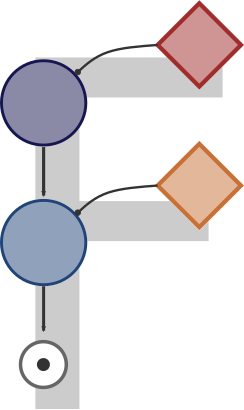
pyhgf.utils.vectorised_belief_propagation.propagation_step#
- pyhgf.utils.vectorised_belief_propagation.propagation_step(network, opt_state, inputs, *, optimiser, time_step=1.0, learning_kind='precision_weighted', weight_update=True, synaptic_uncertainty_settings=None)[source]#
Single propagation step through the network.
Belief-propagation sweep — top-down prediction, leaf prediction error, then the interleaved posterior update + prediction error bottom-up — followed by an optional weight-learning phase. Each step dispatches per element:
Layer: standard per-layer kernel call (unrolled).LayerStack:jax.lax.scanover the stack’s slices.
Top and bottom elements must be
Layer``s. A ``LayerStack’s child below (and parent above) can themselves beLayerorLayerStack; the stack-stack case requires the boundary widths to match.- Parameters:
network (VectorisedNetwork) – The current vectorised network state.
opt_state (optax.OptState) – The current optax optimiser state.
inputs (tuple) – A tuple
(x, y)with the predictors set on the top element and the observations clamped on the bottom element.optimiser (Optional[optax.GradientTransformation]) – The optax optimiser used for the weight-learning phase.
time_step (float) – The time elapsed since the previous step.
learning_kind (str) – The weight-gradient mode passed to
pyhgf.updates.vectorised.learning.learning_weights_vectorised().weight_update (bool) – Whether to apply the weight-learning phase after belief propagation.
synaptic_uncertainty_settings (Optional[SynapticUncertaintySettings])
- Returns:
A tuple
((network, opt_state), output_pred)wherenetworkandopt_stateare updated andoutput_predis the bottom element’sexpected_mean— the prediction of the observations for this step.- Return type:
carry