pyhgf.updates.prediction.continuous.continuous_node_prediction#
- pyhgf.updates.prediction.continuous.continuous_node_prediction(attributes, node_idx, edges, **args)[source]#
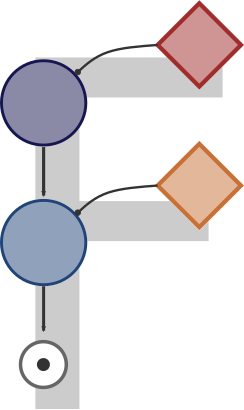
Update the expected mean and expected precision of a continuous node [1].
The precision prediction follows the improved (piHGF) scheme, which marginalises over the parents’ variational Gaussians instead of treating them as point estimates. See
predict_precision()for the precise formula and its two additional variance terms (volatility-coupling moment-generating- function term and value-coupling Laplace term).Note
The parameter structure also incorporates the value and volatility coupling strength with children and parents (i.e. “value_coupling_parents”, “value_coupling_children”, “volatility_coupling_parents”, “volatility_coupling_children”).
- Parameters:
attributes (dict) – The attributes of the probabilistic nodes.
node_idx (int) – Pointer to the node that will be updated.
edges (tuple[AdjacencyLists, ...]) – The edges of the probabilistic nodes as a tuple of
pyhgf.typing.AdjacencyLists. The tuple has the same length as the node number. For each node, the index lists the value and volatility parents and children.
- Returns:
The updated attributes of the probabilistic nodes.
- Return type:
See also
update_continuous_input_parents,update_binary_input_parentsReferences
[1]Weber, L. A., Waade, P. T., Legrand, N., Møller, A. H., Stephan, K. E., & Mathys, C. (2026). The generalized hierarchical Gaussian filter. doi:10.7554/elife.110174.1